NBA Live Betting Strategy: Navigating UK In-Play Markets
 Available in US
Table of Contents
- NBA Live Betting Dynamics: Real-Time In-Play Wagering
- Live Betting NBA from the UK: Timing Considerations
- Spotting Momentum Shifts During Games
- NBA Live Betting Markets Explained
- Using Timeouts and Breaks Strategically
- Cash Out in NBA Live Betting
- Staying Disciplined with Live Bets
- Making Live Betting Work for You

I was watching the Celtics trail by 14 at halftime when the live spread moved to Boston +5.5. Something felt off – they had shot 28% from three in the first half, their star guard had sat the entire second quarter with foul trouble, and the opponent’s hot shooting looked unsustainable. I grabbed that line. Boston won by 9. Live betting offers opportunities that pre-game markets simply cannot match, because information updates in real time while odds sometimes lag behind what observant bettors notice.
In-play wagering can be fast-paced, making strict NBA bankroll management essential to protect your betting budget.
Stay updated with real-time market movements by visiting our top basketball betting guide daily.
The challenge is that in-play betting moves fast and rewards decisiveness. You do not have hours to analyse; you have seconds. A live spread that looks attractive at -3.5 might be -5.5 by the time you finish deliberating. This pace attracts action junkies and punishes the indecisive, which is precisely why edges exist for those who prepare properly and execute without hesitation when opportunities arise.
For UK punters, live betting NBA comes with a unique complication: the games happen in the middle of the night. Most tip-offs land between midnight and 3am GMT, meaning your sharpest betting window occurs when your cognitive function is at its lowest. Understanding how to navigate both the strategic and practical elements of in-play NBA betting separates those who profit from those who make tired, impulsive decisions they regret by morning.
NBA Live Betting Dynamics: Real-Time In-Play Wagering
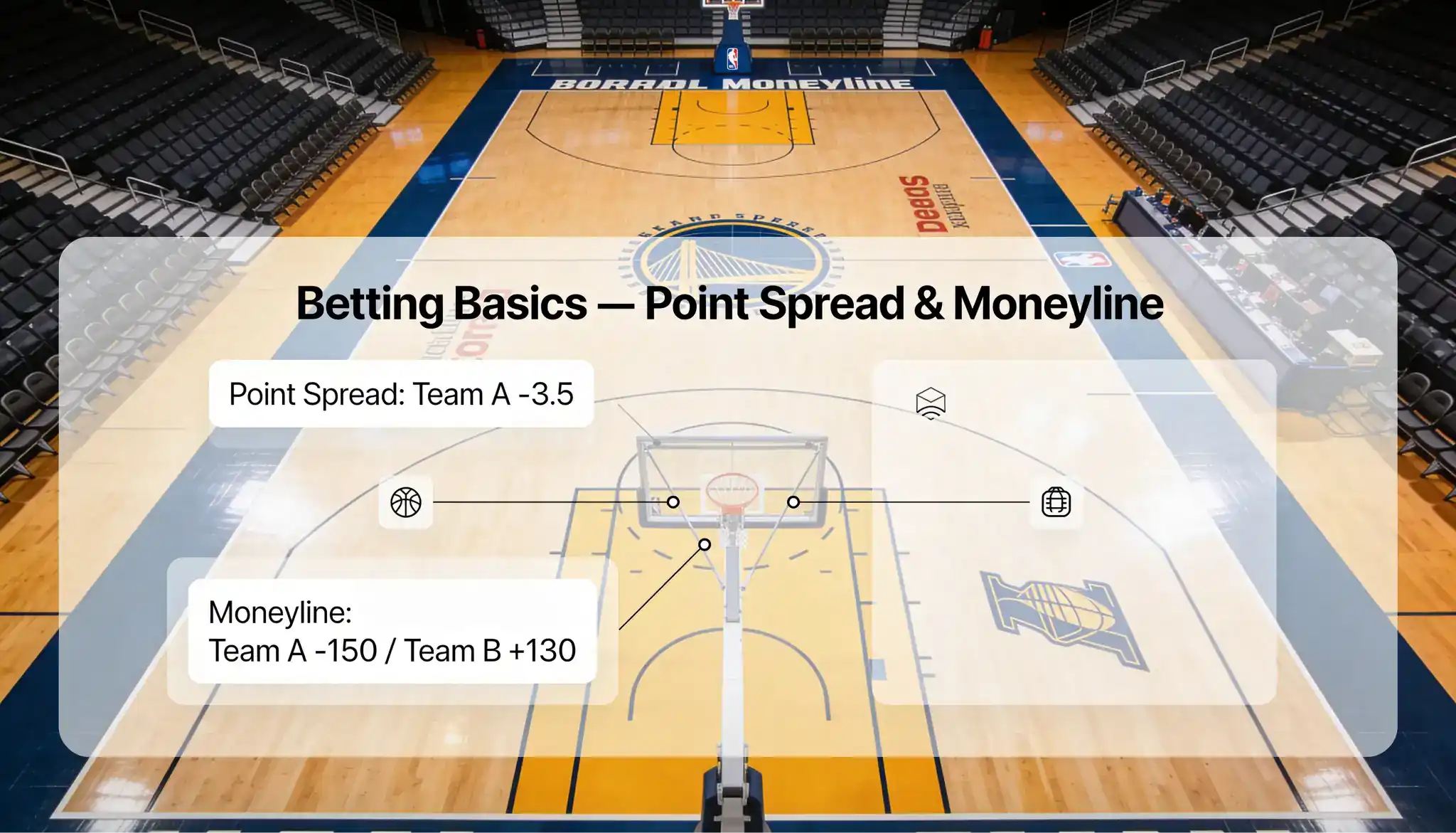
Once tip-off occurs, pre-game lines close and live markets open. From that moment, odds adjust continuously based on the score, time remaining, and statistical models that predict probable outcomes. A team favoured by 6 points before the game might be a 2-point favourite after trailing by 4 at the end of the first quarter, or a 10-point favourite after building an 8-point lead. The numbers reflect current game state rather than pre-game expectations.
The mechanics are straightforward: you see the current live line, decide whether to bet it, and execute. But execution happens against a moving target. The spread that displays on your screen might have already changed by the time your bet processes, especially during action sequences when scores shift rapidly. Most bookmakers handle this through acceptance windows – if the line moves against you by more than a certain threshold, your bet is rejected and you must accept the new number.
Live markets typically include spread, moneyline, and totals for the full game, plus quarter and half lines. Some bookmakers offer props that update in-play, though these are less common because individual statistics are harder to model in real time than team outcomes. The variety of live markets has expanded significantly – 80% of bettors now use mobile devices for wagering, and live betting is perfectly suited to mobile interfaces where you can watch and bet simultaneously.
Speed matters in live betting more than any other market. When you see an opportunity, you need to act. Hesitation costs money because lines move. This does not mean betting recklessly – it means being prepared before the game starts, knowing what situations you are looking for, and executing immediately when those situations appear. The preparation happens beforehand; the execution is decisive.
One structural reality UK bettors face: live odds on American sports are often set by US-based market makers who have faster access to game feeds. UK bookmakers may lag slightly behind, and that lag occasionally creates opportunities. More commonly, though, the lag just means your platform is slower to update rather than offering genuinely better numbers. Understanding your bookmaker’s live betting infrastructure helps set realistic expectations.
Live Betting NBA from the UK: Timing Considerations
The NBA schedule was built for American audiences, not British ones. Games start at 7pm Eastern on weeknights, which translates to midnight GMT. West Coast games tip at 10pm or 10:30pm Eastern – 3am or 3:30am in the UK. If you want to live bet NBA games, you are committing to late nights or early mornings during the week.
This creates a genuine cognitive challenge. Live betting requires quick decisions and clear thinking. Fatigue degrades both. At 2am after a full workday, your ability to assess situations accurately and execute disciplined strategies is measurably worse than at 8pm. I have made some of my worst live betting decisions after midnight, convinced in the moment that I was thinking clearly when the post-mortem revealed otherwise.
My approach now is selective engagement. Rather than trying to watch and bet every game, I identify one or two games in advance that offer the best opportunities for live betting angles. Maybe a matchup I have researched deeply, a game where I expect specific in-game situations to develop, or a contest between teams whose tendencies I know well. Focusing my attention means sharper analysis during the limited time I am watching.
Weekend games offer better timing. Saturday and Sunday NBA games often tip earlier, with afternoon starts in the US translating to evening viewing in the UK. The Sunday slate in particular frequently includes early games that finish by midnight GMT. If you want to live bet without destroying your sleep schedule, weekends are your friend.
Some bettors pre-commit to specific game situations. Rather than watching entire games and seeking opportunities, they decide beforehand: “If Team A trails by 8 or more at halftime, I will bet them.” Then they set alerts and only engage when that trigger occurs. This reduces the time spent watching and waiting while maintaining the ability to capitalise on anticipated situations.
Spotting Momentum Shifts During Games
Basketball is a game of runs. A team can trail by 15 with four minutes left in the third quarter and lead by 5 entering the fourth. These swings happen constantly, and recognising when momentum is shifting before the scoreboard fully reflects it is where live betting edge exists. The question is: what signals precede these shifts?
Foul trouble on key players is one of the most reliable indicators. When a team’s best defender picks up his fourth foul midway through the third quarter, he either sits (reducing defensive effectiveness) or plays cautiously (also reducing effectiveness). The offensive implications when a team’s primary scorer has four fouls are similarly significant. These situations often take several minutes to fully impact the score, giving you a window to act on live lines that have not yet adjusted.
Coaching adjustments – lineup changes, defensive scheme shifts, timeout deployments – signal that one side recognises a problem and is trying to fix it. A timeout called after a 10-0 opponent run often stops the bleeding; the team coming out of that timeout tends to play with more focus for the next few possessions. Conversely, a team that gets outscored 10-0 without calling timeout often continues hemorrhaging because their coach is either out of timeouts or not recognising the crisis.
VSiN’s analysis of live betting suggests that forcing in-game bets leads to poor outcomes – you should enter each game with a specific strategy in mind and wait for opportunities to present themselves. I agree completely. The worst live bets come from wanting action rather than seeing genuine opportunity. Before any game I intend to live bet, I identify what scenarios would make me want to bet each side. If none of those scenarios occur, I bet nothing. That pre-commitment prevents impulsive decisions during the game.
The NBA provides real-time data through its partnership with Sportradar, and that data flows to sportsbooks within seconds of events occurring. Shot attempts, turnovers, fouls, substitutions – everything updates almost instantly. As a viewer, you might notice momentum shifting before statisticians can quantify it. That human observation, combined with statistical awareness, creates the best opportunities. You see the body language change on one bench while the other team’s starters start deferring rather than attacking – the score has not changed yet, but the momentum has.
NBA Live Betting Markets Explained
Live betting opens up market diversity that pre-game cannot match. Beyond the standard spread, moneyline, and total, in-play markets let you bet on individual quarters, specific scoring sequences, and other granular outcomes. Understanding what is available – and which markets offer the best risk-reward – helps you focus attention where it matters.
Live Spread and Totals
The live spread adjusts based on current score and time remaining. If a 6-point favourite trails by 2 with half the game complete, the live spread might sit around pick ’em or even favour the team that was originally the underdog. These adjustments reflect updated win probabilities given current game state. The live total similarly adjusts – a game on pace for 230 points after one quarter will see its total move up from a pre-game number of 215.
Value in live spread betting often appears after overreactions to hot starts. A team that opens the game shooting 70% from three and builds a 12-point first-quarter lead will see spreads move dramatically. If that shooting is unsustainable – and 70% from three is always unsustainable – the opponent becomes underpriced. The skill is distinguishing between legitimate blowouts and hot shooting that will regress.
Live totals present similar opportunities. A first quarter that produces 68 combined points will push live totals sky-high, but defensive adjustments and shooting regression often bring second-half pace back to normal. I have found that betting unders on games with absurdly high first-quarter scoring frequently provides value, provided you believe the pace is anomalous rather than representative.
Quarter Markets
Individual quarter betting lets you isolate specific periods rather than betting the full game. Third-quarter markets, in particular, offer interesting dynamics. Halftime adjustments mean the team that trailed often comes out sharper; conversely, the leading team sometimes coasts. If you believe a trailing team will respond, betting them to win the third quarter often offers better odds than betting them to win the game outright.
Fourth-quarter betting is heavily influenced by game state. Blowouts see starters sit, making unders attractive as backups play lower-intensity basketball. Close games see starters play extended minutes with every possession mattering – overs tend to hit because both teams are maximising their offensive efficiency rather than running clock.
Micro Markets
Some bookmakers offer even more granular options: next team to score, race to 50 points, margin of victory ranges, and similar exotic markets. These carry higher juice because bookmakers need wider margins on markets they cannot price as precisely. I generally avoid them except in very specific situations where I believe I have genuine insight – like betting next team to score when one side just called timeout and is clearly preparing a specific play coming out of the break.
The less liquid and less mainstream a market, the wider the margins and the harder value is to find. Stick to primary live markets – spread, total, quarter outcomes – unless you have strong reason to believe a specific exotic offers opportunity.
Using Timeouts and Breaks Strategically
NBA games include natural pauses – timeouts, TV timeouts, quarter breaks, halftime – that create windows for analysis and bet placement when the action is frozen. These breaks are your friend. Unlike the frantic pace during live play, stoppages give you time to think without worrying that the line will move while you deliberate.
TV timeouts occur at predetermined points in each quarter, typically the first dead ball after the 6:00 and 3:00 marks. These are not called by coaches; they happen automatically for broadcast purposes. Knowing when they will occur lets you anticipate windows of stability. The line you see going into a TV timeout will remain stable for roughly two minutes, which is an eternity in live betting terms.
Coach-called timeouts signal strategic moments. When a coach burns a timeout after an opponent’s 8-0 run, they are trying to disrupt momentum and regroup. The team coming out of that timeout often performs better over the next few possessions – not always, but frequently enough that it matters. Conversely, a team that suffers a run without their coach calling timeout may continue struggling because no tactical adjustment is coming.
Halftime is the longest break and the most valuable for analysis. You have 15-20 minutes to assess first-half performance, identify trends the market might be mispricing, and place bets on second-half or full-game outcomes. The live spread at halftime reflects first-half results, but those results may not represent true team strength. Hot shooting cools, cold shooting warms, and coaches make adjustments. Halftime is often the best moment to bet against what the first half suggested.
I use breaks to check injury information – a player who got hurt late in the second quarter might have their status updated during halftime. I review shot charts and possession data to see if the scoring patterns are sustainable. And I make sure any bet I am considering still makes sense with fresh eyes, because the adrenaline of live betting can make mediocre opportunities look better than they are.
Cash Out in NBA Live Betting
Cash out lets you settle a bet before the game ends, locking in profit or limiting losses at current live odds. The UK sports betting market is projected to reach over $21 billion by 2030, and cash out functionality has become one of its most popular features. But whether you should use it is not as straightforward as the feature’s convenience suggests.
The mechanics are simple. If you bet on a team at +6.5 and they now lead by 8, the cash out offer might return 80% of your potential winnings immediately. Take it, and you guarantee profit regardless of what happens next. Let it ride, and you might win the full amount – or watch the lead evaporate and lose entirely. The bookmaker is offering you certainty at a discount.
That discount is the key consideration. Cash out offers always favour the bookmaker. They are essentially offering you worse odds than the current live market would provide if you could bet the other side and hedge perfectly. The convenience of one-click settlement costs money. Every time you cash out, you are accepting negative expected value relative to letting the bet complete.
So when is cash out justified? In my view, only when you believe the current game state no longer reflects your original analysis. If you bet a team because you thought they were better than the line suggested, and they have indeed proven better, cashing out makes no sense – your thesis is working. If something changed – a key player got injured, the opponent made adjustments you did not anticipate, the game is unfolding in ways that undermine your original reasoning – then accepting reduced profit to exit a situation you no longer like is defensible.
I see many bettors cash out purely from anxiety, locking in small profits that looked big a few possessions earlier. That emotional decision-making is exactly what bookmakers are counting on. The cash out button is designed to be tempting. Resist the urge to use it unless your strategic assessment of the game has genuinely changed.
Staying Disciplined with Live Bets
Live betting is uniquely dangerous for discipline. The constant availability of new bets, the emotional swings as games unfold, the ease of chasing losses with another quick wager – these factors combine to make in-play betting the highest-risk activity for problem gambling behaviours. About 0.3% of adults in England are classified as problem gamblers, with another 2.8% considered at-risk. Live betting likely over-indexes in both categories because of its impulsive appeal.
Pre-set limits are essential. Decide before any betting session exactly how much you are willing to lose, and stop when you hit that threshold. This sounds obvious, but the nature of live betting makes it easy to rationalise one more bet when the limit approaches. The game is still going, another opportunity presents itself, and surely this one will win back what you lost. That thinking destroys bankrolls.
Avoid live betting immediately after losses on the same game. The urge to chase – to bet the other side, to double down, to make back what you just lost – is strongest when the loss is fresh. Taking a mandatory break of at least one quarter before placing another live bet gives emotions time to settle and prevents the worst impulse decisions.
I also recommend keeping a running tally of live betting results separate from pre-game results. Many bettors who are profitable on pre-game markets are unprofitable on live betting because the different pace and emotional intensity expose weaknesses that do not appear in calmer pre-game analysis. If your tracking shows live betting costing you money while pre-game betting makes money, that data tells you where to focus – and where to cut back. For a comprehensive look at how these betting approaches fit together, the core guide to NBA betting in the UK covers the fundamentals that underpin all market types.
Finally, watch for fatigue effects. Live betting NBA from the UK means betting late at night. Tired decision-making is bad decision-making. If you notice your analysis becoming sloppy or your discipline slipping as the clock pushes past 2am, close the app and go to sleep. The games will happen again tomorrow. Your bankroll should still be there when they do.
Making Live Betting Work for You
Live betting rewards preparation, decisiveness, and discipline – not in-the-moment genius. The bettors who profit consistently do their homework before tip-off, know what situations they are looking for, and execute without hesitation when those situations appear. They also know when to walk away, both from individual games and from sessions that are going poorly.
The UK timing challenge is real, and I would not advise anyone to sacrifice sleep regularly for NBA live betting. Treat it as an occasional indulgence on games that genuinely interest you, not a nightly grind that leaves you exhausted and poorer. The entertainment value of watching basketball while betting is substantial – that is why the market exists. Just make sure the entertainment does not become a costly habit.
Start with small stakes until you understand how live odds move and how your own psychology responds to the pace. Track results religiously. Identify whether live betting is actually profitable for you or just more exciting than pre-game betting. The data will tell you where your edge lies, if anywhere. Follow what the data says, not what your excitement wants to believe.
Can you cash out NBA live bets?
Yes, most UK bookmakers offer cash out on NBA live bets. The feature lets you settle bets before the game ends at current live odds. Cash out values update continuously as the game progresses, though the offered amount always includes a discount compared to the theoretical fair value.
How quickly do NBA live odds change?
NBA live odds can change within seconds during active play. Every score, foul, and timeout potentially triggers recalculation. During breaks in play – timeouts, quarter ends, halftime – odds remain stable. The fastest movements occur during scoring sequences when the score changes rapidly.
What is the best quarter to bet on in NBA?
Third quarters often offer value because halftime adjustments create unpredictable swings. Teams that trailed frequently come out stronger, while leading teams sometimes coast. Fourth quarters depend heavily on game state – blowouts favour unders as starters sit, while close games favour overs as both teams maximise effort.
Do live bets include overtime?
Yes, standard live bets on full-game spread, moneyline, and total include overtime. Quarter-specific bets do not include overtime since they cover only the specified quarter. Always check your bookmaker’s rules, as some exotic live markets may have different overtime policies.
Prepared by the how to bet nba editorial staff.